 Lemexi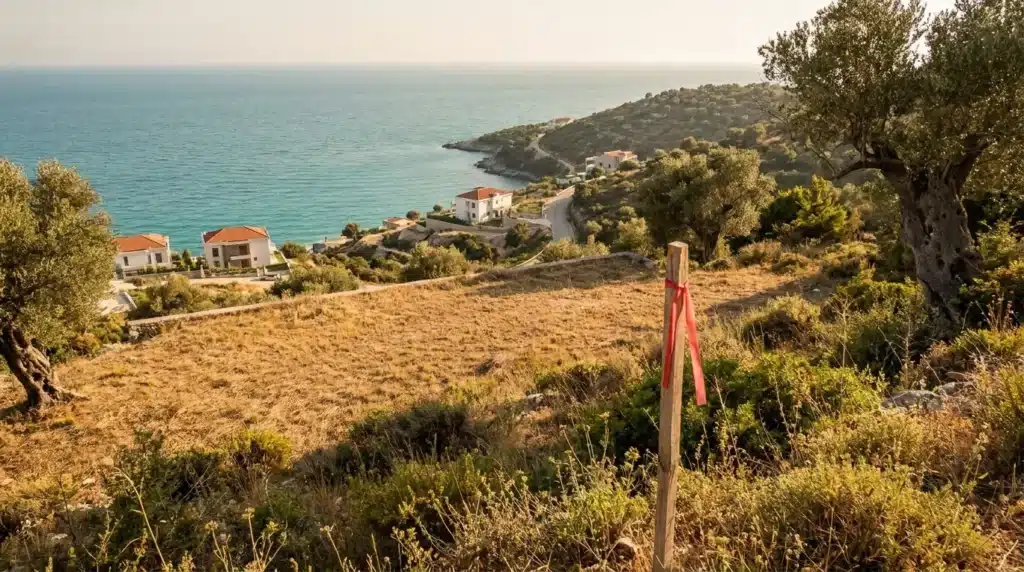
Almost everyone who falls in love with the Albanian coast ends up with the same daydream: find a piece of land above the sea, and build the home you’ve always pictured in your head. Wake up to that view. Plant a garden. Make it yours.
It’s a wonderful dream. And the honest answer is — yes, you really can do it. But before you fall for a plot and hand over a deposit, let us walk you through what actually happens, the same way we explain it to our own clients over coffee. No scare stories, no sales pitch — just the truth, so your dream doesn’t quietly turn into several years of headaches.
This is the question we hear more than any other at Lemexi. So let’s go through it together, calmly, step by step.
Why you can’t just walk in and buy a plot
Here’s the first thing that surprises people. In Albania, a foreigner is not allowed to buy farmland or an empty plot directly, in their own name. This isn’t some hidden trick — it’s written into Albanian law (the old but still-living Law No. 7501 “On the Land”), and the idea behind it is simple: the country wants to protect its farmland from being quietly bought up by outsiders.
Apartments and finished houses? Those you can buy in your own name, no problem. But raw land to build on — that door is closed to you as a private individual.
So how do people do it? They open a small Albanian company. It’s called an SHPK — think of it as a simple limited company that can be 100% owned by you, the foreigner. It usually takes only a couple of days to register. And here’s the important part to remember for later: the company buys the land, so the land ends up in the company’s name — not directly in yours. Hold that thought.
Open your company FIRST — before you even start looking
This one little detail saves people a lot of money, so please don’t skip it. Your company needs to already exist and be active before you go hunting for land — not the other way around.
Let us paint you a picture of what goes wrong otherwise. You find the perfect plot. The owner smiles and says: “Lovely — just leave a deposit, and you’ve got, say, 30 days to register your company and pay the rest.” You agree. You start the paperwork. And then… Albania’s online government systems go down for a few days (it happens more often than you’d like). The clock keeps ticking. Your 30 days run out. And the owner — completely within his rights — keeps your deposit and sells the land to the next person in line.
We’ve watched good people lose real money exactly this way. So our advice is always the same, and it’s boring on purpose: first open the company, open the bank account, put your money in it — and only then start looking. When you finally find your plot, you want to be ready to say “yes” on the spot.
Not every piece of land is even allowed to have a house
Now to the part that catches almost everyone off guard. In Albania, every piece of land has an official “purpose” stamped on it — and that purpose decides what you’re allowed to put there. You can’t simply buy a field and drop a house on it because you like the view.
In plain terms, land usually falls into one of these:
- Residential land — the kind you’re actually after. This is where homes and villas are allowed.
- Agricultural land — meant for farming. Building a home here is heavily restricted, and turning it into building land is a slow, uncertain fight.
- Tourist land — for hotels and resorts, not your private house.
- Commercial or industrial land — for shops, offices, warehouses and the like.
See the problem? The land you genuinely want — residential, with a sea view — is the rarest of them all. The best spots near the water were mostly snapped up years ago, and what’s left is often priced so high that, once you sit down and do the maths, building your own place stops making any sense at all.
Getting the building permit — the step that quietly eats a year
Let’s be optimistic and say you found a beautiful plot — around 20 ares (that’s 2,000 m²). Naturally you ask: “How big a house can I build here?” And the honest answer is: it depends. There’s no single nationwide rule. Each town hall sets its own building limit for each area — how much of the plot you’re allowed to cover, and how tall you can go. The exact same size plot can allow a generous villa in one town and only a modest cottage in another.
To even apply, you need an architect to draw up the plans and put their signature on them. And here’s a rule that stops a lot of dreamers in their tracks: until you hold a valid building permit, you cannot connect water, sewage or electricity. Nothing. No permit, no utilities — full stop.
So how long does that permit take? Brace yourself. The local offices are short-staffed and naturally put the big developers first. In a good case you’ll wait 6 to 8 months. We’ve seen people wait up to a year and a half. And the whole time, your company has to stay alive — paying its monthly taxes and accountant — because a “sleeping” company won’t get a permit at all.
And even then — you still need builders
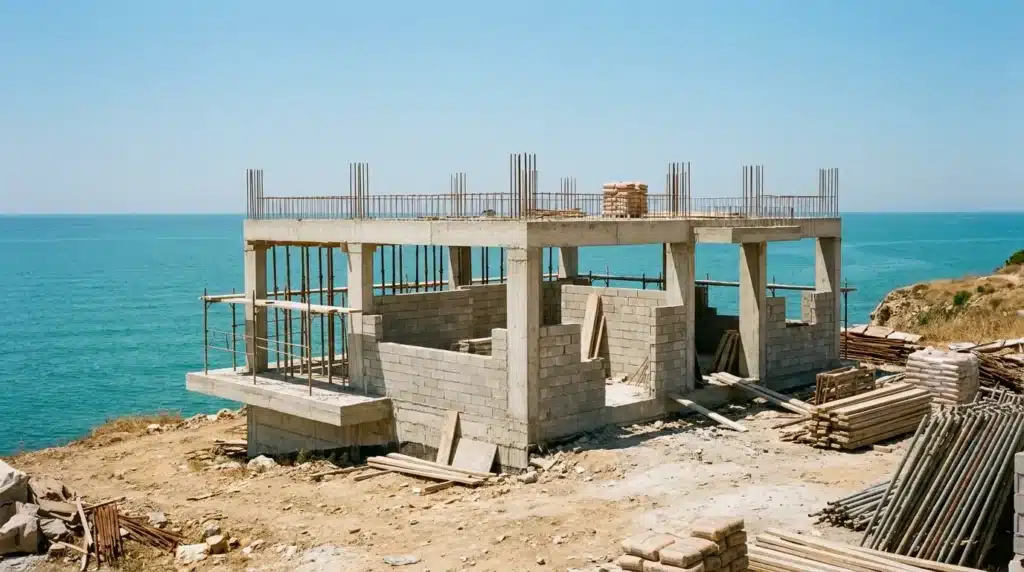
Permit finally in your hands (best case, you’re already about a year in), now you need a construction crew to actually do the work. Sounds easy. But remember — the builders you chatted to a year and a half ago have lives too. They may be busy on someone else’s project by now. Nothing that far ahead is ever guaranteed.
And when the dust settles and you finally add up every real cost — the land, the company fees month after month, the architect, the long permit wait, and the build itself — a lot of people quietly realise something uncomfortable: building from scratch in Albania often costs more and takes far longer than simply buying a home that’s already finished.
The catch almost nobody warns you about
The land sits inside your company. And the house you just built? It belongs to the company too. So on paper, a company owns both — not you.
Take a second with this one, because it’s the part that trips people up most. You went through everything — the company, the permit, the whole build — and the finished house still isn’t in your name. Right now, the company owns the land and the house standing on it.
The first job is to fix the relationship between the two. As things stand, the land “owns” the house; you need it the other way around — the house owning its land. So the company applies for an ownership certificate that ties them together that way. Once it comes through, the land is written right into the house’s certificate, and you finally have one clean thing: a house, with its land included.
But remember how slowly that building permit crawled along? The certificate can be even worse. Going through the cadastre office (in Albania, the ASHK) can take a year — sometimes two. And every single month of that wait, your company still has to be alive and paying its taxes, or the whole thing stalls.
There’s a small surprise hidden in there too. When the cadastre finally issues your certificate, it doesn’t always catch the little ways the builders drifted from the architect’s drawings — a bedroom that was supposed to be 20 m² that somehow ended up 20.5. Often it simply goes through and you’re fine. But it’s worth knowing: that certificate is only ever as clean as the build behind it.
Then — and only then, once the house owns its land — you’ve earned the right to the final step: your company sells the house to you, personally. And that’s where the purchase taxes come in, plus tax on the “profit” the company technically made by building it. None of this is scary; it’s all completely doable. It’s just several more chapters — and a fair bit more time and money — than anyone pictures while standing on an empty plot, imagining their future living room.
Very often, there’s a far simpler path
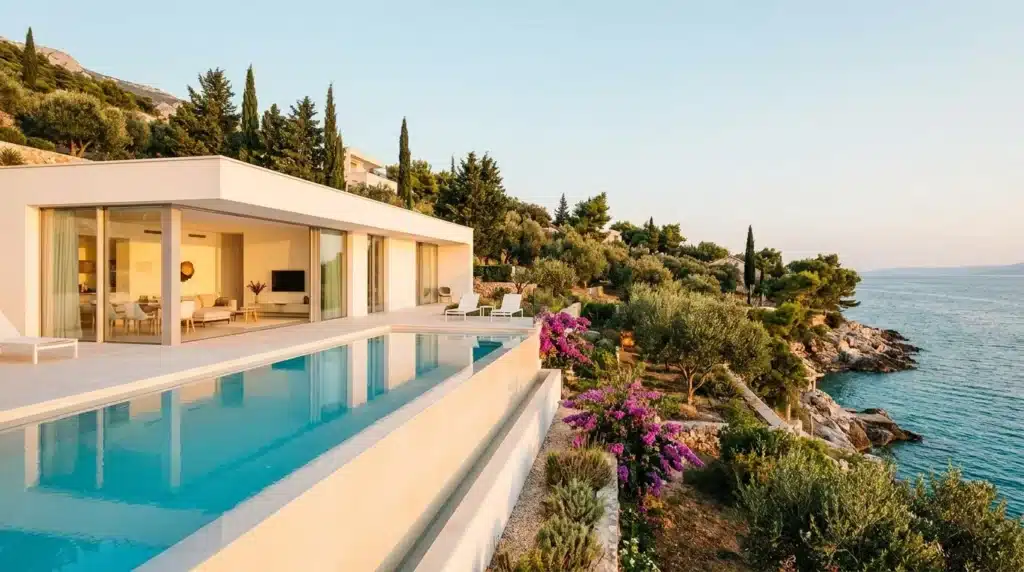
Here’s what tends to happen when a client sits down with us. We ask two simple questions — why do you want land, and what exactly do you dream of building? Then we put real numbers next to the answers. And again and again, we discover that a ready-built home would give them almost everything they wanted — with the water, sewage and certificate already in place, and the land already written into that certificate, in their name.
That last detail is the whole magic of it: you skip the “a company owns my house” problem entirely. You can get a feel for what’s out there in the ready homes we have listed on the site.
The moment people actually see the difference in the numbers, the direction usually changes — and almost always for the better.
So should you give up on the dream? Absolutely not
Please don’t read any of this as “it’s too hard, forget it.” That’s not the message at all. The message is the opposite: this dream is completely doable — you just want to walk into it with your eyes open, knowing exactly what’s waiting at each turn, instead of finding out the expensive way.
More often than not, the home you’ve been picturing is closer than you think. You just need to look in the right direction, with someone beside you who’ll do the honest maths instead of telling you what you want to hear.
So if you’re dreaming of a place by the Albanian sea — whether that means building on land or finding something ready — just talk to us, or have a look at the homes we already have. We’ll tell you straight which path actually gets you there.
— With warmth, the Lemexi team.